Every major AI model, private to your organisation.
Public organisations can't paste their work into consumer AI tools, and buying everyone a separate AI subscription is expensive and ungoverned.
- Data can't leave their control: pasting research, internal documents, or correspondence into consumer AI tools is a non-starter for a public body.
- Per-seat SaaS doesn't scale: individual AI subscriptions across the organisation are costly, ungoverned, and impossible to standardise.
- The assistant they had was expensive to run: an always-on managed vector database billed for capacity around the clock, used or not.
- …and rough at the edges: large PDFs could crash the server, some file types wouldn't ingest, and sharing a custom assistant didn't work.
They wanted their own assistant: in their cloud, on their login, under their rules.
One private platform on Amazon Bedrock: leading models from Anthropic, Amazon, Meta, Mistral, DeepSeek and Qwen, custom assistants over the organisation's own documents, and admin governance, all running in the organisation's own AWS account.
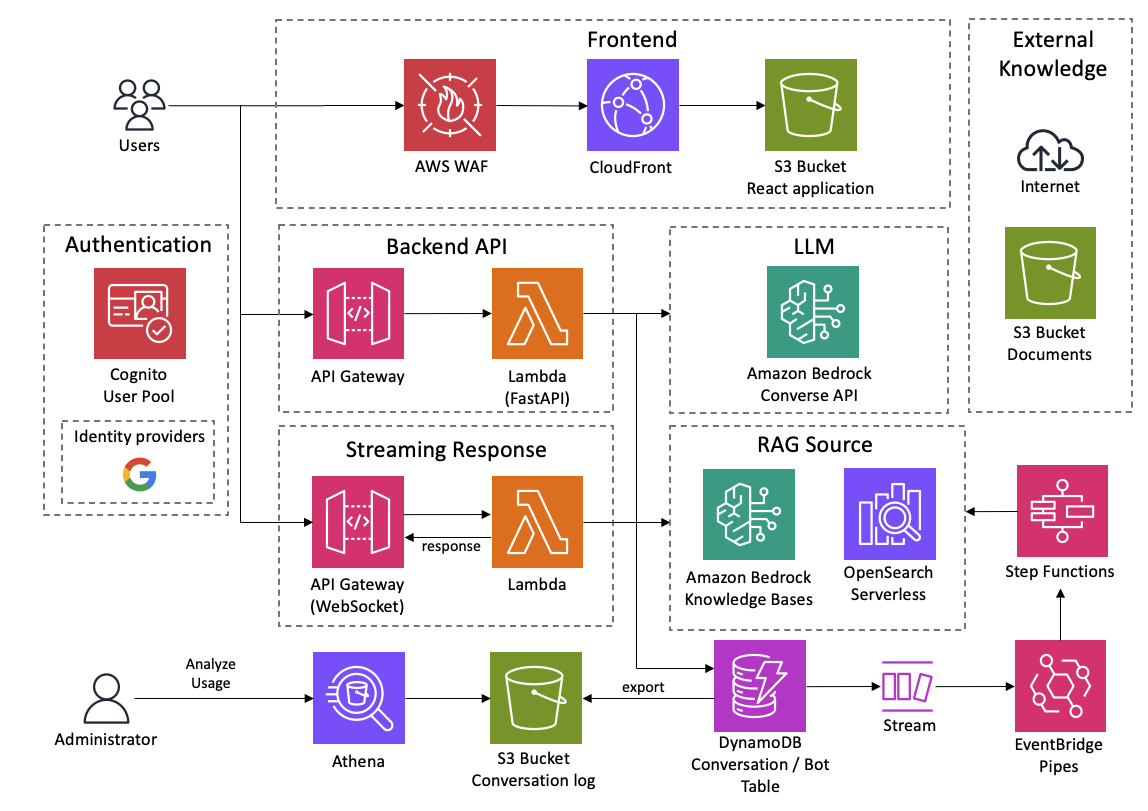
// no data leaves the account, and there are no per-seat AI subscriptions. Staff sign in with the organisation's own Google Workspace.
// from the delivered build; cost figures modelled / illustrative.
“Every major AI model, private to the organisation, in its own EU cloud, and a re-architecture that deleted the most expensive always-on component.”
One assistant, every major model
15+ models · one dropdownStaff pick from a single list spanning the frontier (Anthropic Claude, Amazon Nova, Meta Llama, Mistral, DeepSeek and Qwen) with no separate logins or per-vendor subscriptions. Every model is verified to work on the account's billing, so there are no dead options, and US-only models are routed cross-region transparently.
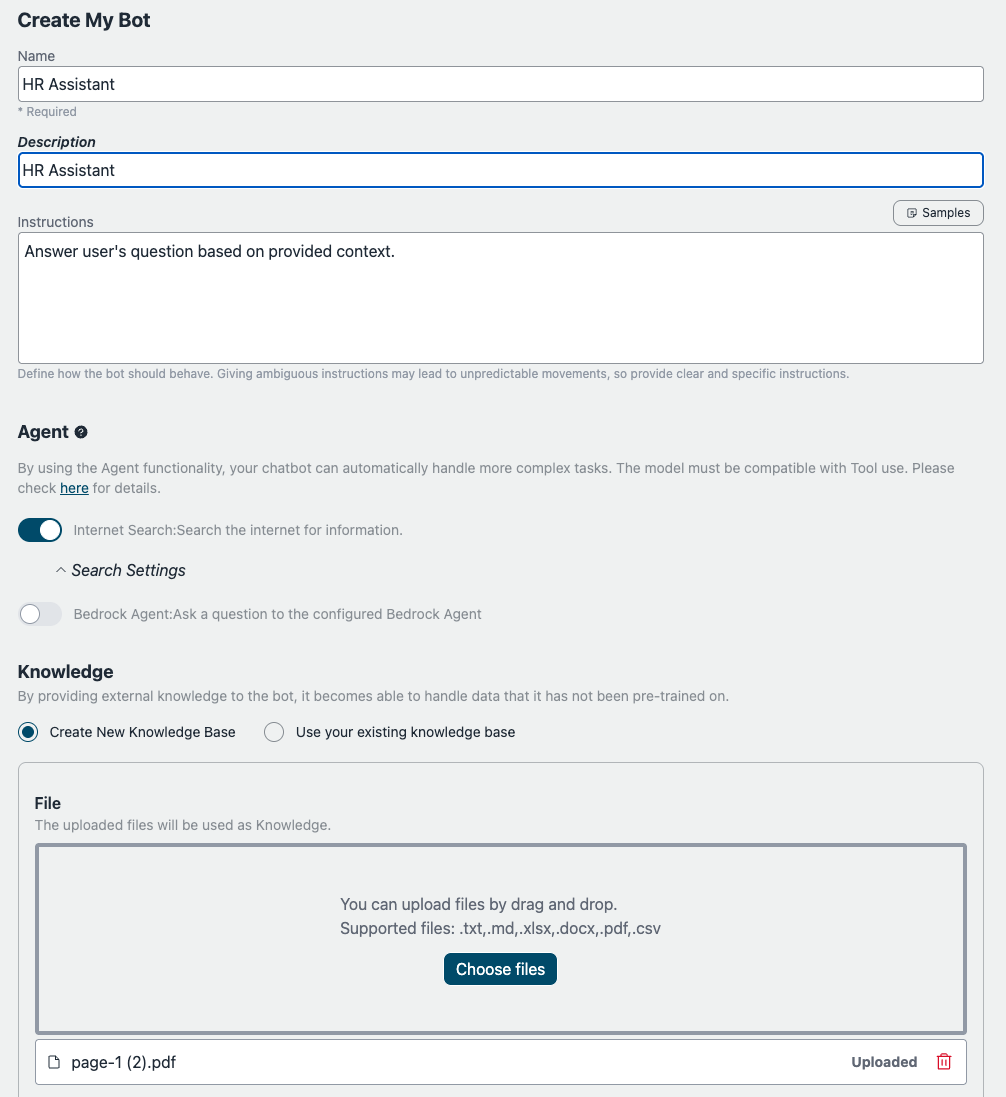
Assistants over your own documents
RAG · custom botsEach team builds a custom assistant (a name, an instruction, and a knowledge base of its own documents), then shares it with colleagues or publishes it as an API. As part of hardening, we widened document support so large PDFs and more file types ingest reliably.
Private by design
your cloud · your loginEverything runs in the organisation's own AWS account in the EU region, behind Google Workspace single sign-on restricted to staff email domains, with content guardrails and group-based permissions for who can create and publish assistants.
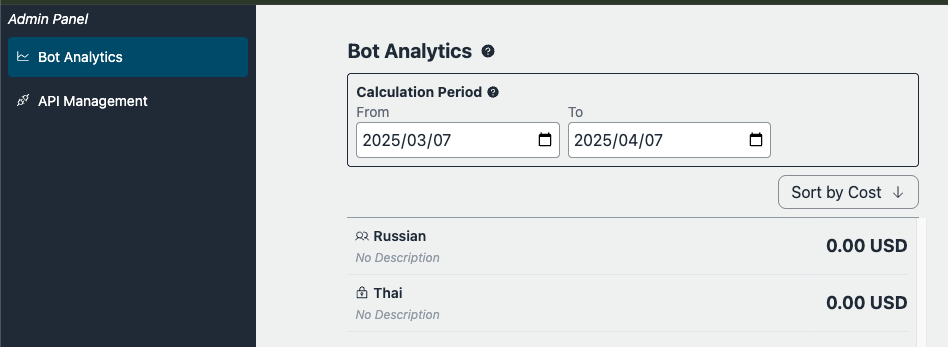
Governed & observable
admin · usage analyticsAn admin console with per-assistant usage and cost analytics means the organisation sees exactly what's being used and what it costs: the right source of truth for a real bill once the pilot runs.
The biggest lever in the engagement: deleting the most expensive always-on component.
Before: the assistant's retrieval layer ran on a managed vector database billed for provisioned capacity 24/7, a fixed few-hundred-dollar monthly floor, paid whether anyone used the assistant or not.
After: we moved retrieval to Amazon Bedrock Knowledge Bases backed by S3 Vector storage, and the app tier to right-sized, auto-scaling ECS Fargate containers. Storage-backed vectors are billed for what you store and query, so idle cost drops to near zero and the platform scales with real use.
// same capability, a usage-shaped bill instead of an always-on one.
Amazon Bedrock
The model layer (Claude, Nova, Llama, Mistral, DeepSeek and Qwen), plus Bedrock Knowledge Bases (S3 Vectors) for RAG and Guardrails for content safety. Nothing talks to APIs outside the account.
ECS Fargate + CDK
A React front end on CloudFront and a Python/FastAPI backend on ECS Fargate with live streamed responses, the whole stack defined as AWS CDK infrastructure-as-code and deployed in eu-central-1.
Cognito + Google
Amazon Cognito federated to the organisation's Google Workspace, locked to staff email domains, with group-based permissions and per-assistant usage analytics.
services involved: aws · ai · product development