From inbox chaos to automated operations.
Most established SMBs run on tools that work, but don't talk to each other. The result is hours of daily copy-paste between an inbox, a spreadsheet, a calendar, and a CRM.
If you run a growing business, the morning looks like this: someone opens the shared inbox to 60–120 emails (orders, quote requests, delivery questions, complaints, invoice queries, all mixed together) and reads each one, works out what it is, finds the customer, and turns it into a task. By hand. Then the same person checks stock levels in a spreadsheet and chases the deals that have gone quiet. Most of the day is gone before the real work starts.
None of these tools is broken. The cost is in the gaps between them: the manual routing a person does all day to keep them in sync.
- Slow first response. Urgent complaints and delivery escapes sit behind routine email, sometimes for hours.
- Things slip. A quote follow-up is forgotten; an overdue opportunity quietly goes cold.
- Stock surprises. Low stock is noticed only when an order can't be filled.
- Inconsistent CRM. Data entry is the first thing skipped when things get busy, so the records drift out of date.
// roughly 3 hours every day went into triage and data entry a machine should do.
If your team spends its mornings as a human router between an inbox, a spreadsheet, a calendar, and a CRM, this is for you.
Three n8n workflows sit on top of the tools you already have and use AWS Bedrock (Claude) to do the reading, deciding, and data entry for you.
your existing systems
- support inbox
- excel price/stock
- shared calendar
- in-house CRM
n8n: orchestration
- Inbox Triage Bot
- Stock & Price Watchdog
- CRM Health Digest
the brain
- AWS Bedrock
- Claude Haiku 4.5
- reads · decides · drafts
// no rip-and-replace: your tools stay exactly as they are; the automations do the glue work between them.
// illustrative, at a representative email volume.
“The AI brain for the entire operation costs about the price of a coffee per month.”
Inbox Triage Bot
every inbound email · real-timeBefore: a person reads every email, works out what it is, finds the customer, and makes a task, all day. After: the email lands and, within seconds, a triaged, routed, customer-linked task exists with a draft reply ready for a human to approve.
Every support email is read, classified (Order / RFQ / Delivery / Complaint / Invoice), scored for priority and sentiment, linked to the customer in your CRM, and turned into a routed, prioritized task with a draft reply, in seconds.
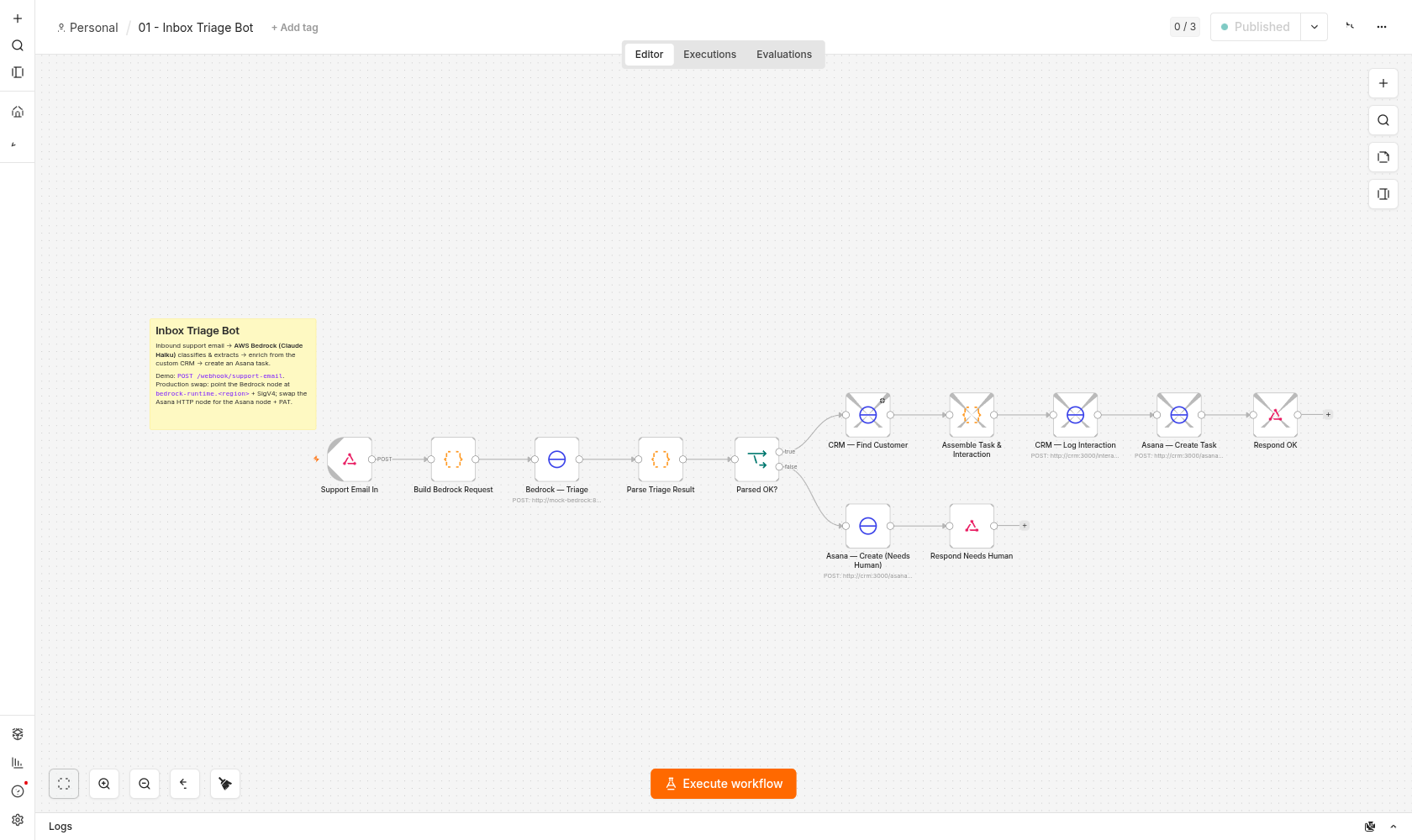
A real run: a damaged-goods complaint from a key account → Complaint · P1 · negative, matched to the customer in the CRM and routed to the Escalations queue with a draft reply. Quote requests route to Quotes, orders to Orders; an unknown sender is still triaged and tagged so nothing falls through. And when the AI's output can't be parsed, the email is escalated to a human, never silently dropped.
Stock & Price Watchdog
daily · 06:30Before: low stock is noticed when an order can't be filled. After: a prioritized restock briefing and a calendar reminder are waiting for purchasing at 06:30, before anyone opens the inbox.
Each morning it reads your Excel stock sheet, flags low stock and thin margins, has Claude write a prioritized restock briefing, books a "reorder review" on the calendar, and emails purchasing the digest, before anyone opens the inbox.
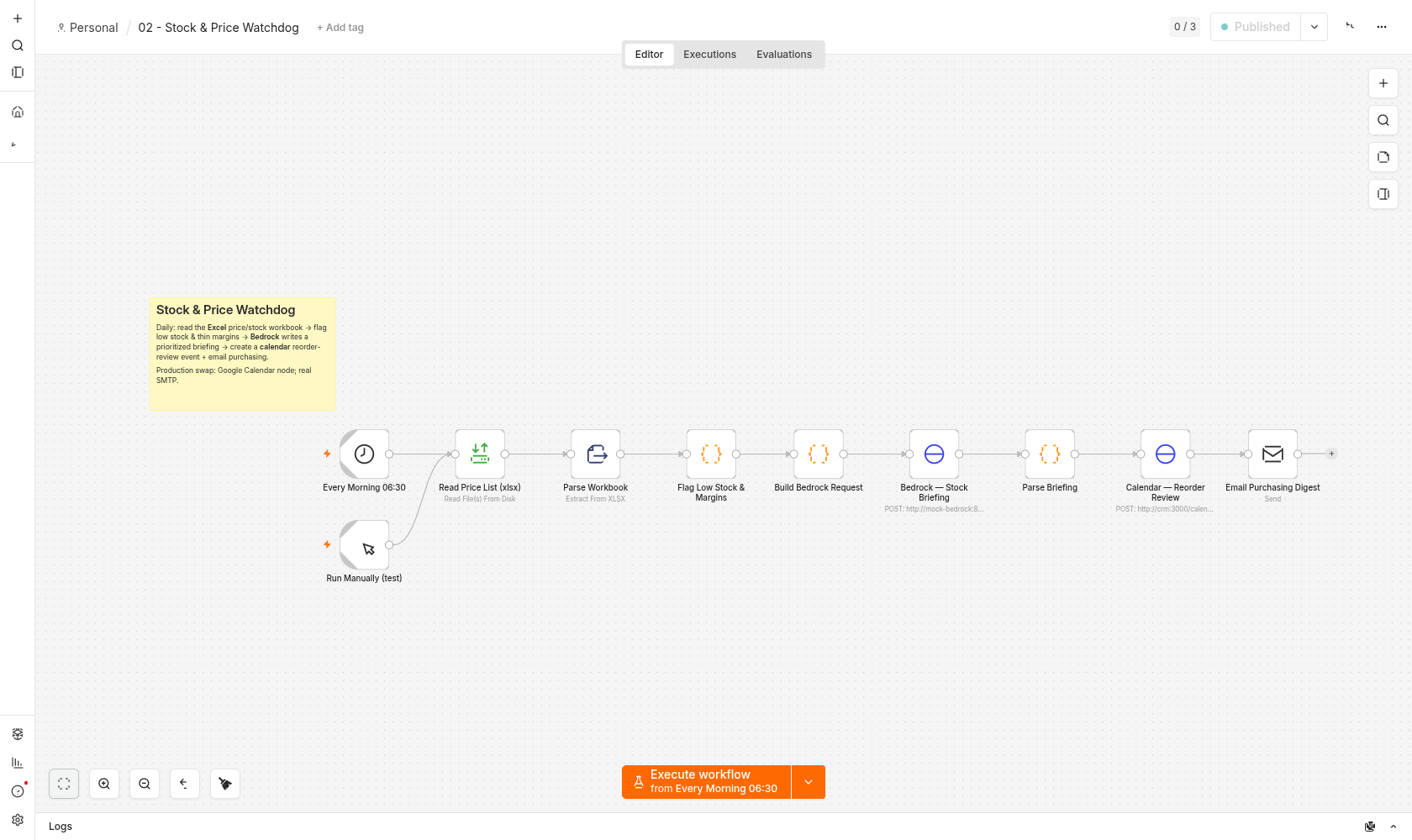
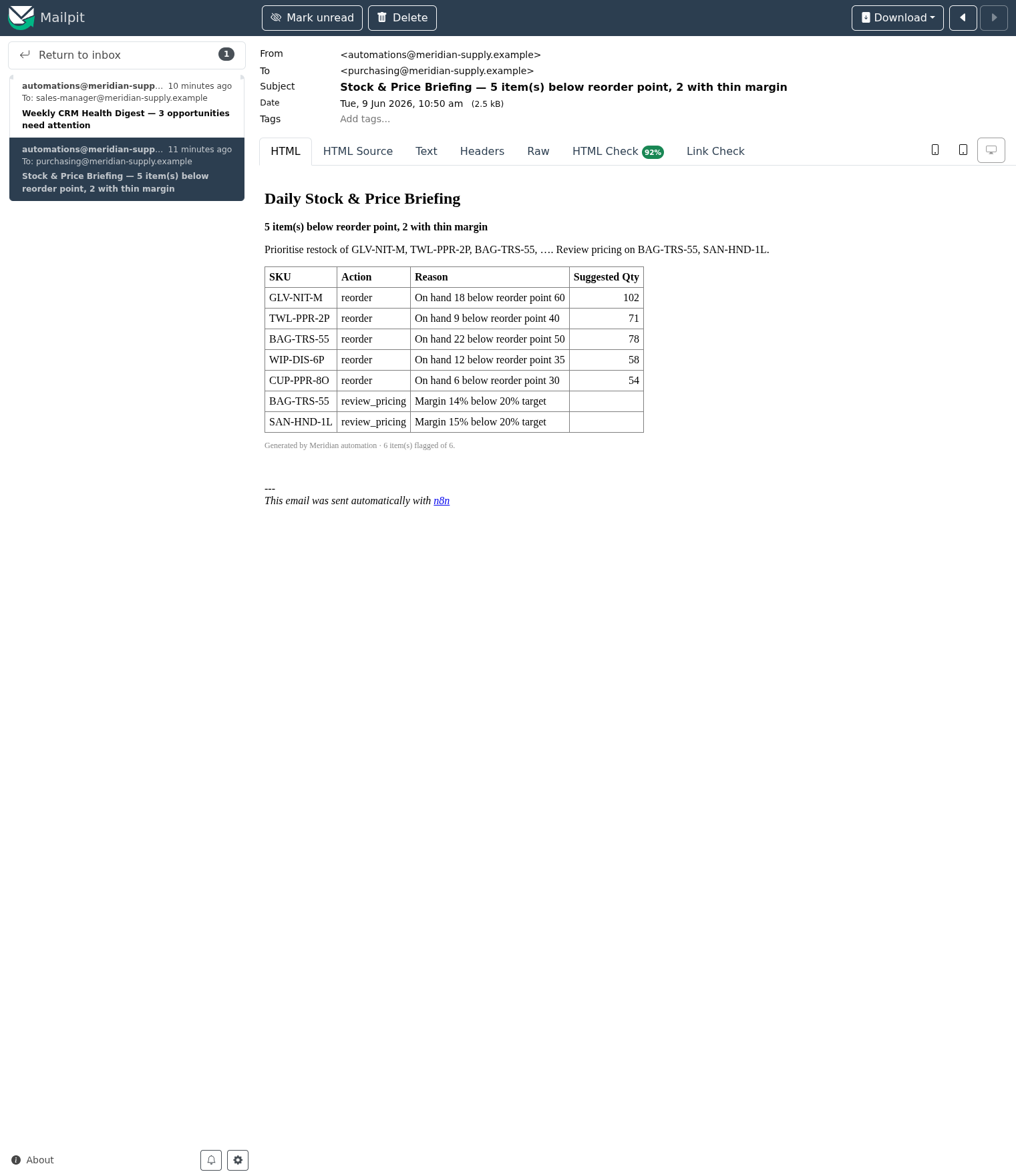
A real run: flagged 5 items below reorder point and 2 with thin margins, created a calendar hold for the next morning, and emailed purchasing the prioritized action table.
CRM Health Digest
weekly · mon 08:00Before: opportunities go quiet and quietly die. After: every Monday the deals about to go cold are back in front of the right account manager, with follow-up tasks already created.
Each week it finds the deals about to go cold and puts them back in front of the right account manager, with follow-up tasks created automatically.
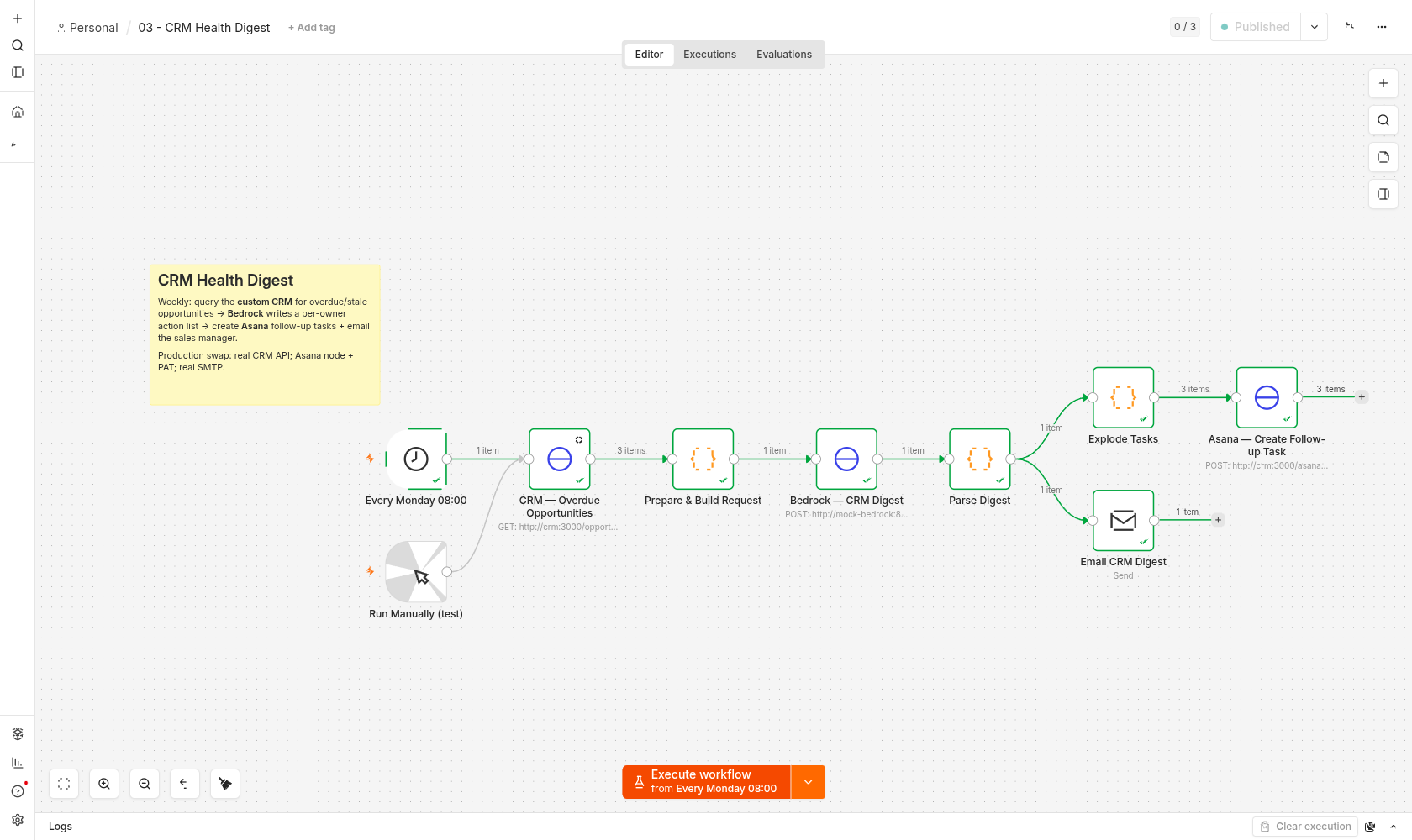
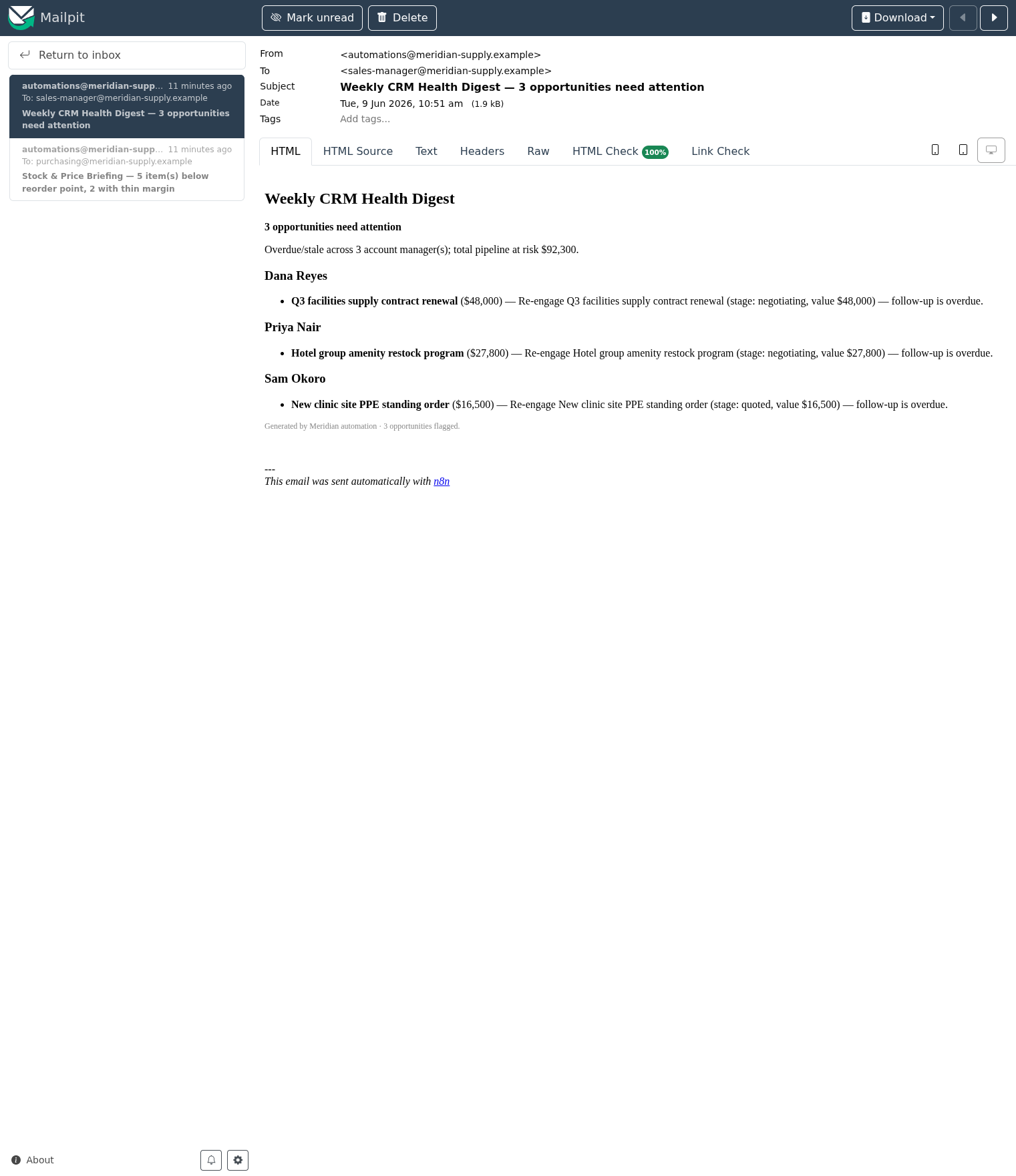
A real run: surfaced 3 overdue opportunities worth $92.3k in pipeline (a $48k renewal, a $16.5k standing order, a $27.8k restock), created a follow-up task for each routed to its owner, and emailed the sales manager a per-account-manager digest.
Two pieces of technology do the heavy lifting. Here's what they are, without the jargon.
n8n
A visual wiring board for your software. You connect the apps you already use and lay out what should happen, step by step. It's open-source and self-hosted, so it runs on infrastructure you control and your data stays with you.
AWS Bedrock
Amazon's managed service for running top-tier AI models inside your own AWS account: how the automation gets a brain without sending your business data off to a third-party tool.
Claude (Haiku 4.5)
The AI that does the reading and deciding: Anthropic's Claude, run through Bedrock. The Haiku model is fast and cheap enough to read every email, sheet, and record for about the price of a coffee a month.
services involved: business process automation · ai · aws
- Nothing gets replaced. Email, Excel, calendar, and the in-house CRM stay exactly as they are; the automations do the glue work between them. Going live is a per-integration config swap, not a rebuild.
- A human stays in control. Every task carries a draft reply for approval; when the AI is unsure or its output can't be parsed, the item is escalated to a person, never silently dropped.
- Your data stays yours. The AI runs in your own AWS account through Bedrock; nothing is used to train anyone's model.